
The Ancient Story Simmering in Your Kitchen
There is something deeply reassuring about a pot of barley on the stove.
It doesn’t rush.
It doesn’t demand attention.
It simply simmers — the way it has for thousands of years.
What most of us don’t realise as we stir barley into soups or fold it through roasted vegetables is this:
The grain in our kitchens today can be traced back to one small region of the world nearly 10,000 years ago.
Not many origins.
Not scattered beginnings.
One.
Modern barley — Hordeum vulgare — began its journey in the wild grasslands of the southern Fertile Crescent, in what is now the Israel–Jordan region.
There it grew as its untamed ancestor, Hordeum spontaneum, long before farming as we know it existed.
People were gathering it even 17,000 years ago — long before fields were planted in neat rows. They harvested it by hand, probably unaware that they were forming one of the earliest relationships between humans and grain.
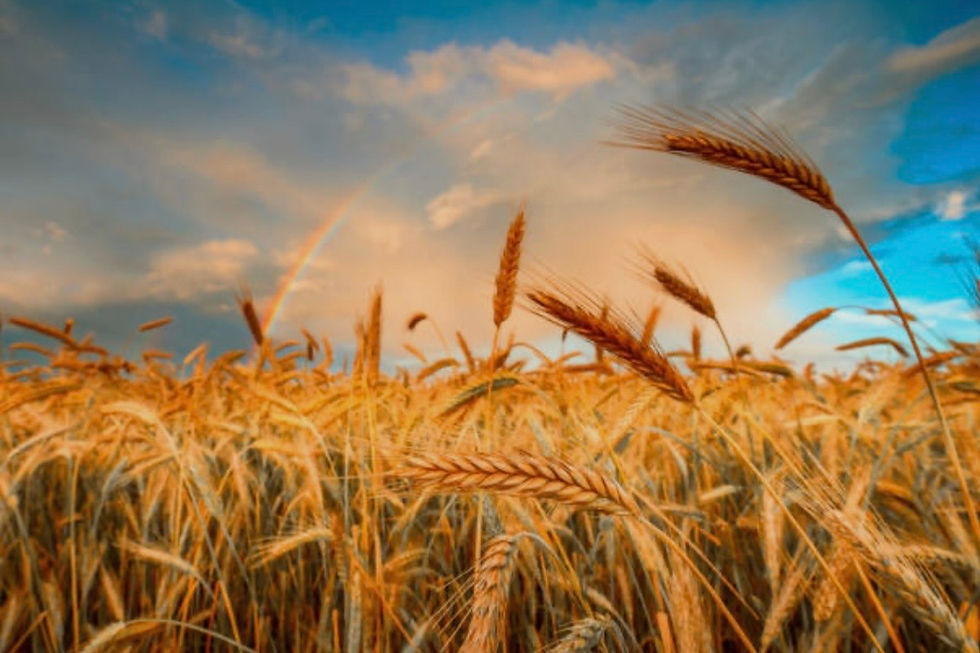
At some point, something subtle but life-changing happened.
A natural variation appeared in wild barley — a plant whose seeds did not shatter and fall to the ground as easily.
That tiny difference meant the grain stayed attached long enough to harvest more efficiently. Early farmers would have noticed. They would have kept those seeds.
And from that quiet act of selection, domesticated barley was born.
Scientists have since compared the genetic “fingerprints” of wild barley populations across the Fertile Crescent with barley grown around the world today.
The closest match?
Wild barley from the Israel – Jordan area.
That means the barley we cook now — in British kitchens, Scandinavian bakeries, Himalayan villages, North American breweries — all traces back to that one region.
It’s extraordinary to think about.
When you tip pearl barley into a saucepan, you’re holding the descendant of wild grasses that once swayed along the Jordan Valley.

As barley travelled over centuries — carried by traders, farmers, and migrating communities — it adapted.
In the Himalayas it developed new local forms.
In Europe it became a staple in bread and porridge.
In colder climates it proved resilient and dependable.
But genetically, it still carries the imprint of that original beginning.
There’s something grounding in that continuity.
In our 21st-century kitchens, surrounded by global ingredients and modern appliances, barley offers a direct line to early agriculture.
It connects us to the first farmers who chose seeds carefully and saved them for the next season.
It connects us to hands that harvested without machinery. To fires that cooked in clay pots. To meals shared long before written recipes existed.
And perhaps that’s why barley still feels so right in simple cooking.
It belongs in slow soups.
In hearty stews.
In warm grain salads eaten at wooden tables.
In bread that fills the house with a nutty aroma.
It’s not flashy. It’s not fashionable. It doesn’t spike and crash like modern food trends.
It endures.
The remarkable research that uncovered barley’s single origin might sound technical, full of DNA comparisons and genetic markers. But at its heart, the story is beautifully human.
A small wild population in one landscape gave rise to a crop that would nourish civilisations.
That lineage has not been broken.
The grains soaking in your kitchen today are part of that same story.
When we choose barley now — for its flavour, its nourishment, its sustainability — we are also choosing continuity. We are stepping into a chain of care that began thousands of years ago.
I find that quietly inspiring.
Because cooking with barley is not just about nutrition. It’s about participation.
Participation in one of humanity’s oldest agricultural decisions.
Participation in a grain that survived migration, climate shifts, and cultural change.
Participation in a story that began in wild grass and now sits in our cupboards.
So perhaps the next time you cook barley, you might slow down just a little.
Notice the weight of it in your hand.
The way it transforms with heat and water.
The patience it asks of you.
And remember:
This grain has been feeding people since before history had pages.
And now, it’s feeding you.
Tonight, cook barley.
Not just for nourishment — but for connection.


Comments